The envelope method gives every euro of variable spending a category before the month begins. It is one of the oldest budgeting techniques, and one of the most effective at changing a specific habit. Its weakness was always the upkeep. This article explains how the method works, why it helps, and how Copio runs it on your card payments without a spreadsheet.
Figures come from one fictional household used for illustration: a 27-year-old graduate renting alone in Utrecht, in the Netherlands, who takes home €3,100 net a month. The salary is anchored on official graduate data: Dutch higher professional education (HBO) graduates earn an average of €3,322 gross a month a year and a half after graduating, according to the HBO-Monitor 2025; our graduate, a few years in, earns €4,000 gross plus holiday pay. The screens are from the Copio app.
Where the envelope method comes from
The original version was physical. On payday, you withdrew cash and divided it into labelled envelopes: groceries, outings, petrol. Spending came out of the matching envelope. When it was empty, that category was over for the month.
The method works because it makes a limit tangible. Behavioural economists call the underlying habit mental accounting: people do not treat money as one undifferentiated pool, they mentally assign it to budgets and judge spending against each one (Thaler, Mental Accounting Matters, 1999). Envelopes simply make those mental budgets explicit.
The cash version has a problem today: most of us no longer pay in cash. In France, cash fell to 43% of point-of-sale transactions in 2024, when card payments overtook cash for the first time (Banque de France). Envelopes need to follow the card.
The rule: every euro gets a role before the month starts
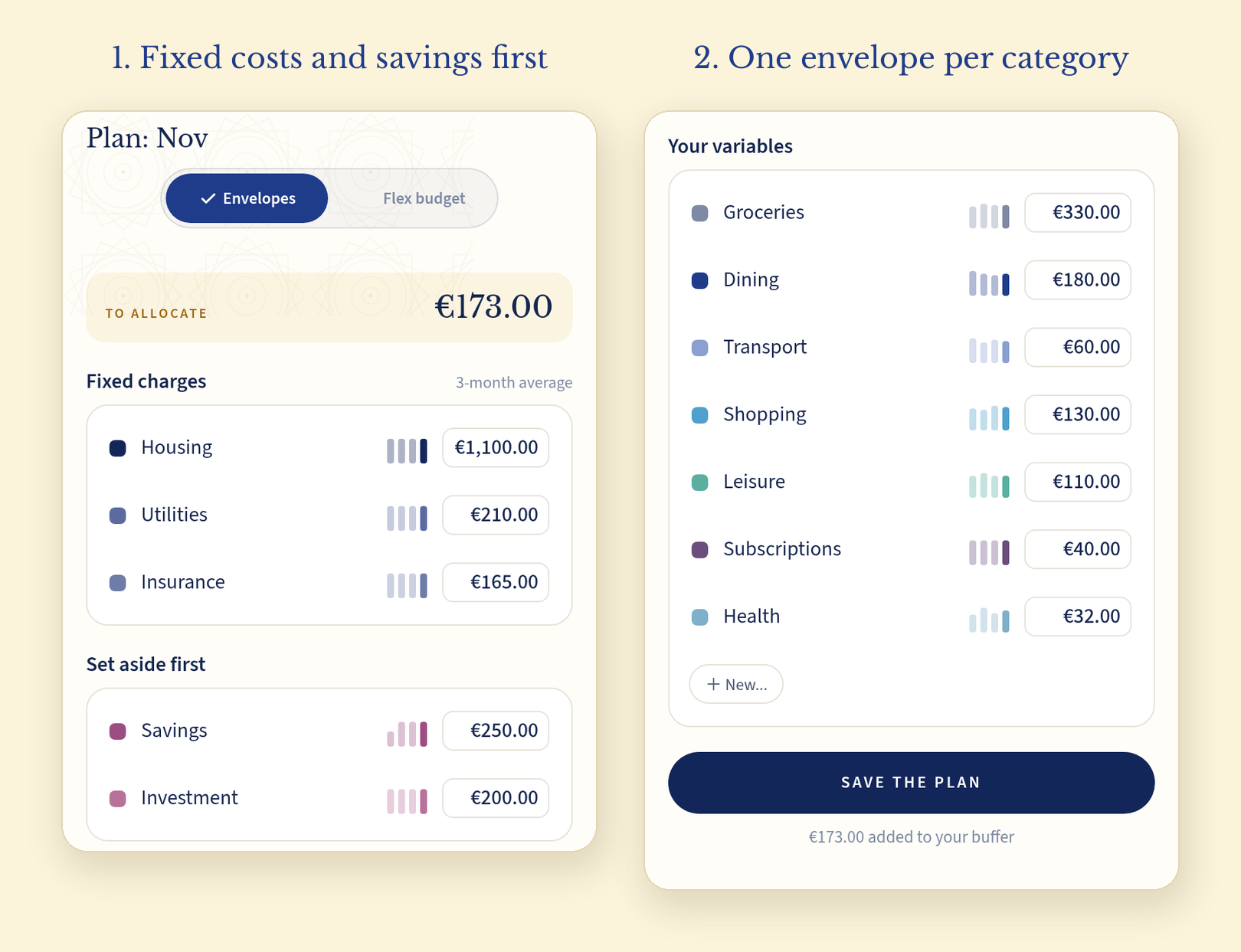
A digital envelope budget is built in a fixed order. In Copio, the plan for next month looks like this:
- Expected income: €3,100, taken from your last observed salary.
- Fixed costs: rent €1,100, utilities €210, insurance €165. In the Netherlands the insurance line is mostly the mandatory basic health insurance, which costs €157 a month on average in 2026. Fixed costs are reserved before anything else and are never offered to cover an overspend.
- Savings and investment, first: €250 and €200. You pay yourself before you spend.
- Annual provisions: €120 a month towards a €1,440 trip next July.
- Envelopes: the variable spending you actually decide on.
- The buffer: whatever is left unassigned.
At the top of the screen, a pill shows what is still to allocate. Each euro you give to an envelope reduces it. When it reaches zero, the app tells you that every euro has a role. If you stop before zero, the rest goes to the buffer when you save the plan: validation never blocks.
Envelopes prefilled from your real spending
The hardest part of any budget is the first figure. How much do you really spend on groceries? Most people underestimate it.
Copio does not start from a blank page. Each envelope is prefilled from your last three months of transactions, and each row shows a small bar chart: three bars for the months you lived, one for the amount you are planning. You can see at a glance whether the plan is realistic or aspirational.
To adjust an envelope, you open the row and type an amount, or use the shortcuts: your usual amount, or the same as a given month. Categories you spent on but did not plan appear as one-tap suggestions with their average. An envelope you no longer need can be swiped away, and its euros return to the amount to allocate.
Subscriptions get their own envelope rather than hiding in fixed costs, so that a forgotten streaming service shows up where you can cut it.
During the month: what is left, envelope by envelope
Once the month has started, the envelope view becomes a reading. Every card payment is categorised and lands in its envelope. For each one, you see what is left and a bar comparing spending to plan.
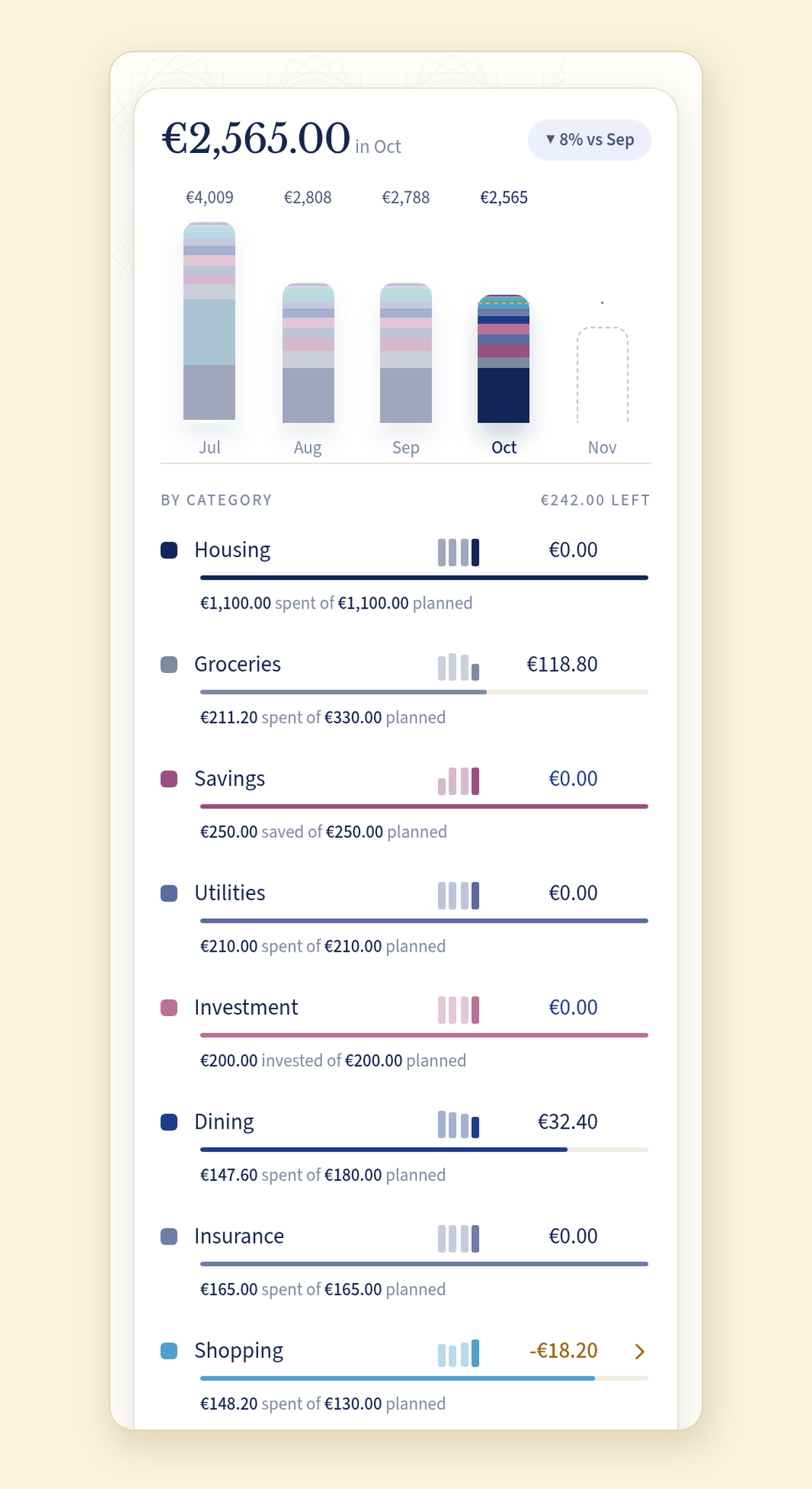
On 19 October, our household has €118.80 left for groceries and €32.40 for dining. Shopping is €18.20 over. Copio shows that in amber, never in red: overspending one envelope is normal, and the plan is there to show it, not to scold.
When an envelope overspends, you have three options:
- Leave it: the buffer absorbs the difference.
- Rebalance: open the plan and move money from an envelope that still has some left.
- Learn from it: if shopping overspends three months in a row, the envelope is too small, not you.
The plan never blocks a payment. It is a reading of your month, not an enforcement mechanism.
Transactions that file themselves
The reason most people abandon digital envelopes is the sorting. Every card payment has to land in the right envelope, and bank labels are cryptic.
In Copio, your accounts are connected in read-only mode and transactions are categorised automatically. When a merchant is ambiguous, you file it once. The sorter shows what would be left in the envelope after filing, and a checkbox lets Copio remember the rule for that merchant. Next time, it files itself.
Envelopes or a single flex budget?
Envelopes are the most precise style, and the most demanding. If five to seven categories feel like too many, Copio's other style, the flex budget, manages all variable spending as one amount and lets you watch only the categories you care about. You can switch at any time, and switching back proposes an envelope split from your history.
Envelope or flex budget: how to choose
Promotional note: Copio is the company publishing this article. The household and its figures are fictional and used for illustration only.