
Envelope budgeting gives each spending category its own limit. Flex budgeting manages all everyday spending as a single number. Both start from the same foundation: income in, fixed costs and savings out first, and what remains is what you actually decide on. This article explains how each method works, who each one suits, and how Copio lets you run either one, or switch between them, on your real accounts.
All figures below come from one fictional household used for illustration: a 27-year-old graduate renting alone in Utrecht, in the Netherlands, who takes home €3,100 net a month. The salary is anchored on official graduate data: Dutch higher professional education (HBO) graduates earn an average of €3,322 gross a month a year and a half after graduating, according to the HBO-Monitor 2025; our graduate, a few years in, earns €4,000 gross plus holiday pay. The screens are from the Copio app.
The part both methods share
Most budgets fail for the same reason: they start with spending. You list what you think you spend, the month disagrees, and the spreadsheet is abandoned by the 20th.
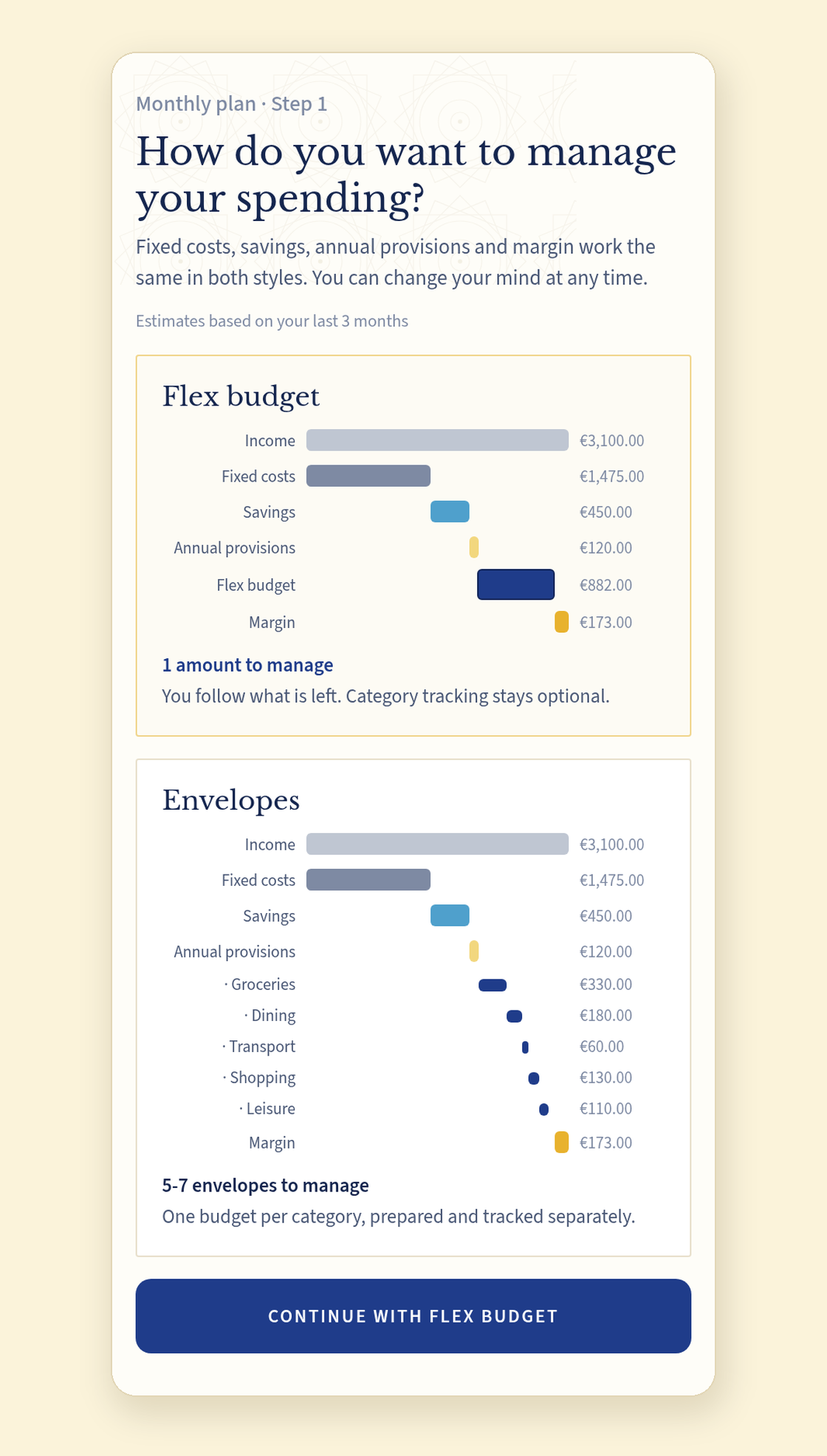
Both styles in Copio start from the other end. Before a single euro goes to groceries, the plan reserves:
- Fixed costs: rent, utilities, insurance (for our Utrecht household, €1,475 a month, including the mandatory Dutch basic health insurance). Copio prefills them from your last three months of transactions.
- Savings and investment, first: the amount you want to put aside, before anything else. This is the "pay yourself first" principle, explained in our article on the monthly plan.
- Annual provisions: a monthly slice of costs that do not arrive every month, such as holidays or a yearly insurance premium.
- The buffer: what you leave unassigned on purpose, to absorb the unexpected.
Only what is left is your variable spending. That is where the two methods differ.
The envelope method: one limit per category
The envelope method comes from a habit that predates bank cards: putting cash for each expense into a labelled envelope at the start of the month. When the "restaurants" envelope is empty, dining out is over until next month.
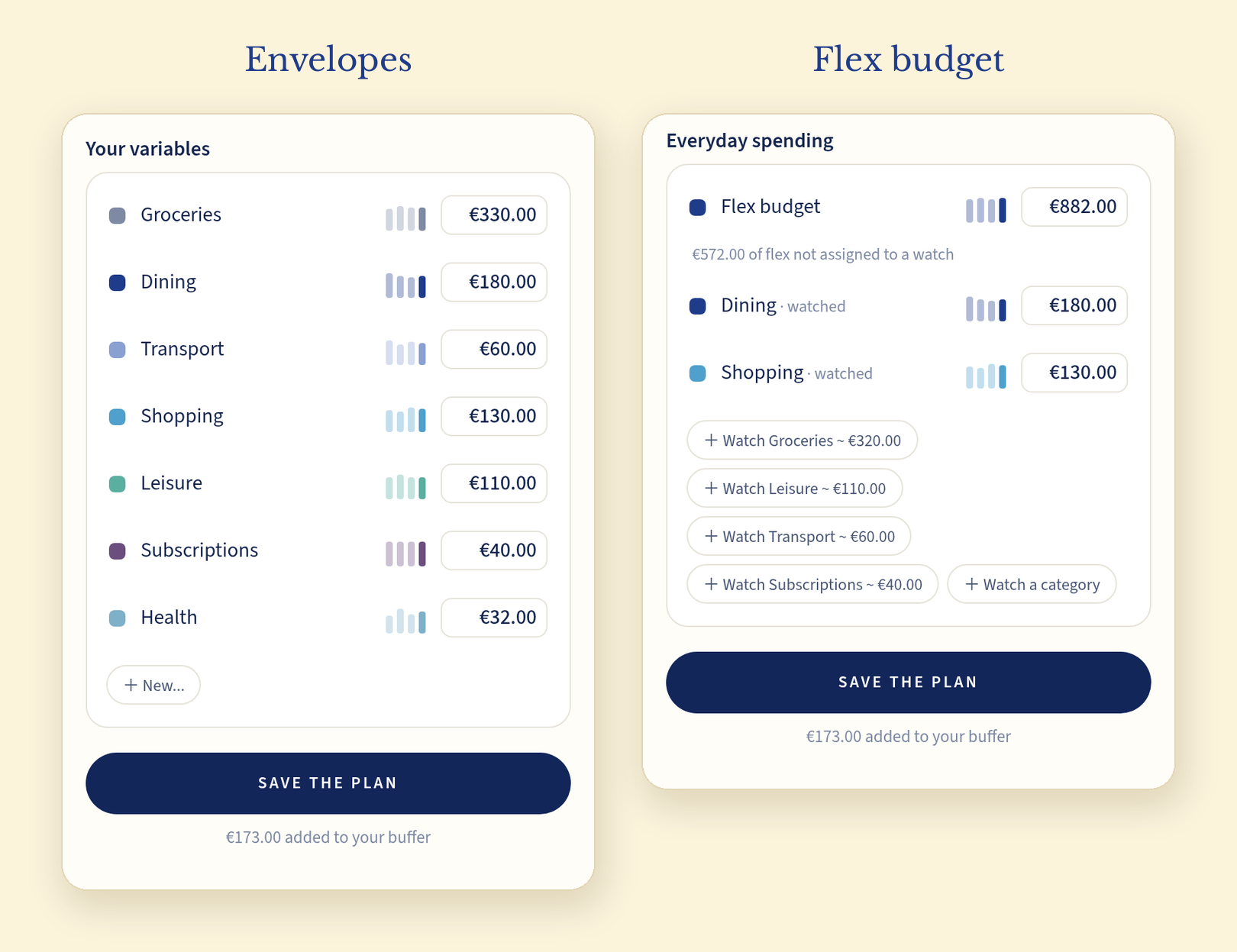
In Copio, each envelope is a spending category with its own planned amount. The household above has seven: groceries €330, dining €180, transport €60, shopping €130, leisure €110, subscriptions €40 and health €32, €882 in total.
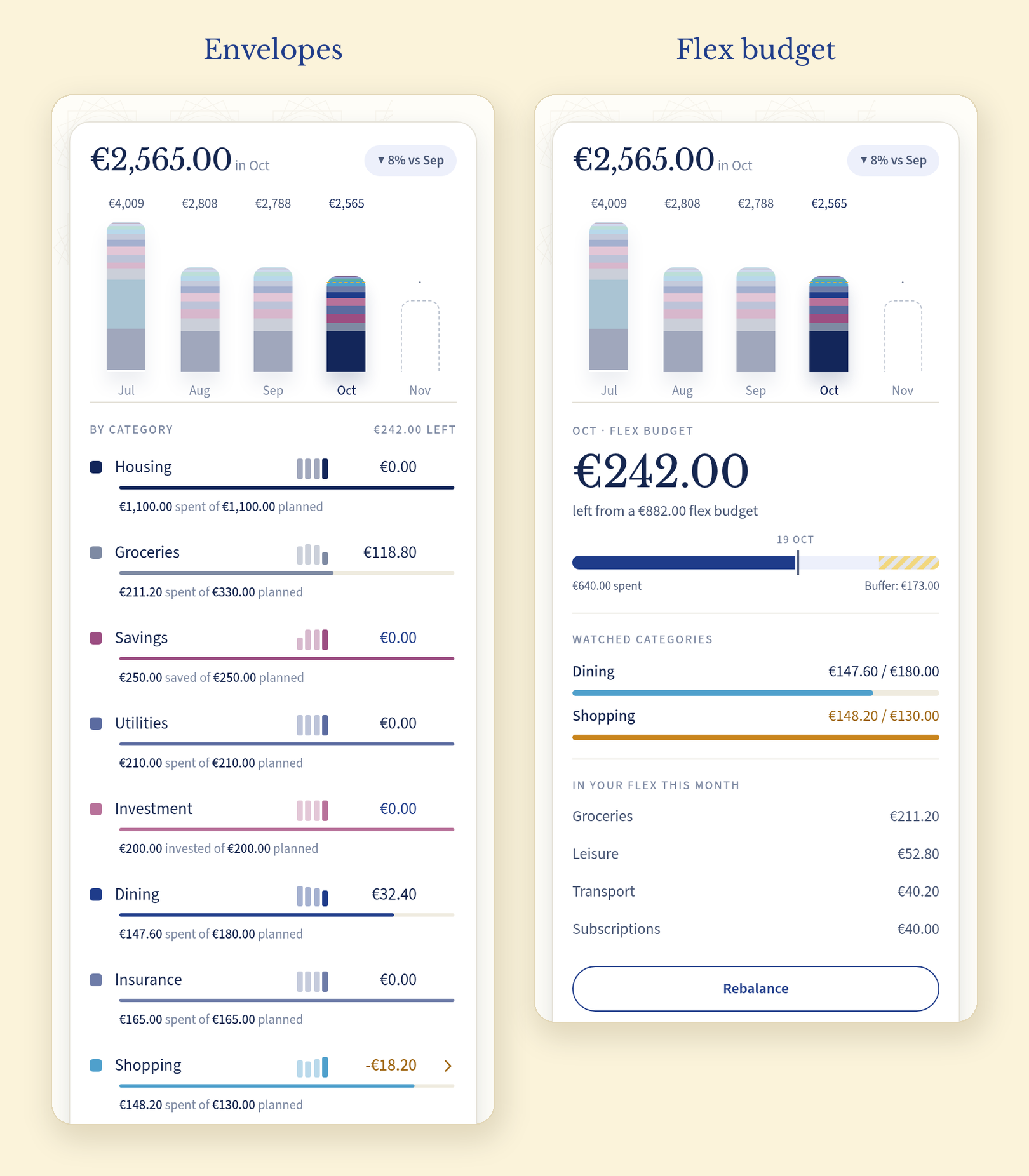
During the month, each category shows what is left, with a bar comparing spending to plan. On 19 October, groceries stand at €211.20 of €330 and dining at €147.60 of €180. Shopping has gone €18.20 over its €130, which the app shows in amber rather than red. It is information, not an alarm.
Envelopes suit you if:
- You want to change one specific habit, and need to see it on its own line.
- You like detail and do not mind a few minutes of preparation each month.
- Your categories are stable from month to month.
How the envelope method works in Copio, in detail
The flex budget: one number for the month
Flex budgeting keeps the same foundation but stops dividing variable spending. Groceries, restaurants, transport and shopping share one amount, here €882. The question you ask during the month is no longer "how much is left for restaurants?" but "how much is left, full stop?".
The method was popularised in the United States by the budgeting app Monarch, which describes flex budgeting as three buckets: fixed, non-monthly and flexible. Copio keeps that structure and adds the buffer as a separate line, so overspending has the same story in both methods.
You can still watch a category inside the flex budget. Our household watches dining (€180) and shopping (€130). A watched category shows its own progress, but no money moves in or out of it: it is a reading, not a separate pot.
Flex suits you if:
- You mostly want to know how much you can still spend this month.
- Five to seven envelopes feel like bookkeeping.
- Your spending moves between categories from one month to the next.
How the flex budget works in Copio, in detail
The two methods side by side
Here is the same plan for November, prepared in each style. Fixed costs, savings and annual provisions are identical; only the variable section changes.
And the same month, read on the 19th. Spending is identical, and so is the €242 left; only the reading changes.
| Question | Envelopes | Flex budget |
|---|---|---|
| What you plan each month | 5 to 7 category amounts | 1 amount, with optional watched categories |
| What you follow during the month | What is left in each envelope | What is left in the flex budget |
| What happens when one category overspends | It shows in amber; you can rebalance from another envelope or the buffer | Other categories absorb it automatically inside the flex budget |
| Monthly preparation | Adjust each envelope, prefilled from 3 months of history | Validate the proposal in one tap, or adjust it |
| Best for | Changing a specific habit | Keeping a simple routine |
How to choose
Ask yourself one question: what do you check most often when you look at your account?
If it is "can I still afford this?", you want one number, and flex will hold your attention longer. If it is "why did dining cost so much again?", you want envelopes, at least until that habit is under control.
The choice is not permanent. Many people start with envelopes to understand where their money goes, then move to flex once their categories are stable. The reverse also works: someone on flex who keeps overspending on one category can watch it, and then move back to envelopes if that is not enough.
In Copio, switching is immediate, for the current month and the next:
- Envelopes to flex: your variable envelopes are added together into the flex amount. Nothing is lost, and spending already recorded stays visible.
- Flex to envelopes: Copio proposes a split of the flex amount based on your spending history. You confirm or adjust it before it applies.
What makes either method stick
Budgeting methods are well known. What usually breaks them is the work around them: entering transactions, sorting them, rebuilding the plan every month. Copio takes that work off your hands:
- Accounts connected in read-only mode: transactions arrive and are categorised automatically. When a merchant is ambiguous, you file it once and Copio can remember the rule.
- A plan proposed, not typed: each month starts from your last three months of real spending, not a blank page.
- No blocking, no red: the plan never stops a payment. It shows where you stand, and overspending is shown in amber.
- A buffer by default: euros you have not assigned flow into the buffer instead of disappearing.
- One-tap renewal: in flex, the next month's plan is ready from your last validated plan; you validate or adjust.
The method matters less than the habit. Pick the one that matches how you already think about money, and let the app do the arithmetic.
Promotional note: Copio is the company publishing this article. The household and its figures are fictional and used for illustration only.