A flex budget manages all your everyday spending as one number. Fixed costs, savings and irregular annual costs are still planned line by line. Everything else, from groceries to restaurants to a new pair of shoes, shares a single amount. During the month there is only one question left: how much of it remains? This article explains how flex budgeting works, when it beats envelopes, and how Copio runs it.
Figures come from one fictional household used for illustration: a 27-year-old graduate renting alone in Utrecht, in the Netherlands, who takes home €3,100 net a month. The salary is anchored on official graduate data: Dutch higher professional education (HBO) graduates earn an average of €3,322 gross a month a year and a half after graduating, according to the HBO-Monitor 2025; our graduate, a few years in, earns €4,000 gross plus holiday pay. The screens are from the Copio app.
Why one number instead of seven
Classic category budgeting asks you to plan and follow five to seven envelopes every month. It is precise, and it is a lot of upkeep. Most people do not actually want to manage seven budgets. They want to know whether they can say yes to dinner on Friday.
Flex budgeting answers that question directly. The method was popularised by the American budgeting app Monarch, which describes it as three buckets: fixed, non-monthly and flexible. Fixed and non-monthly costs are planned in advance and then mostly left alone. Only the flexible bucket needs attention during the month.
Spending also moves between categories naturally. A month with more dinners out often has fewer shopping trips. In an envelope budget, that shows up as one envelope over and another under, and you rebalance. In a flex budget, it simply nets out.
How the flex budget is calculated
In Copio, the plan follows one equation:
income - fixed costs - savings and investment - annual provisions - flex budget = buffer
For our household in November:
| Line | Amount |
|---|---|
| Expected income | €3,100 |
| Fixed costs (rent, utilities, insurance including the mandatory Dutch basic health insurance) | -€1,475 |
| Savings and investment, set aside first | -€450 |
| Annual provision (travel next July) | -€120 |
| Flex budget | -€882 |
| Buffer | €173 |
The flex amount is not a guess. Copio proposes it from your last three months of variable spending, and you adjust it. The buffer is kept separate from the flex budget on purpose: it is the reserve that absorbs a bad week, so that overspending has a place to go before it touches your savings.
Preparing the month: one amount, optional watched categories
The flex plan looks like the envelope plan with one difference: the variable section is a single line, "Flex budget", with its amount and a bar chart of what you actually spent in recent months.
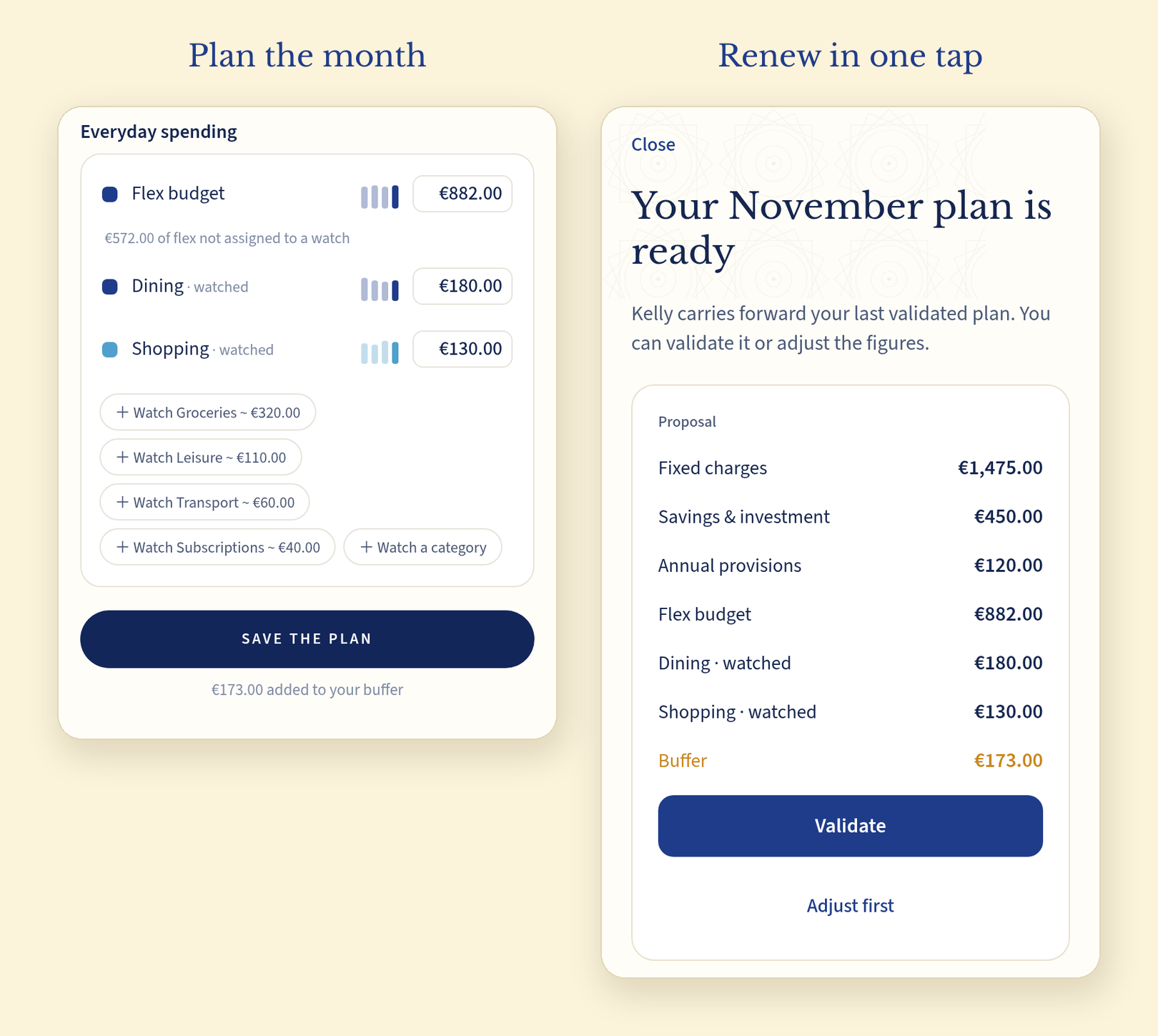
Inside the flex budget, you can watch a category you want to keep an eye on. Our household watches dining (€180) and shopping (€130). The remaining €572 of flex is not assigned to any watch. A watched category is a reading: its progress is shown on its own row, but money never moves into or out of it. If you want to steer it more tightly, that is the moment to consider envelopes.
The monthly ritual, reduced to one tap
The biggest difference with envelopes is what happens at the end of the month. Instead of rebuilding the plan, Copio prepares next month's plan from your last validated one. You see the proposal (fixed costs, savings, provisions, flex amount, watched categories and buffer) and validate it in one tap, or adjust it first.
The monthly consent stays. The ceremony goes.
During the month: a gauge and a hatched buffer
Once the month has started, the flex reading is a single gauge. On 19 October, our household has spent €640 and has €242 left out of €882. The marker shows today's date, so you can tell at a glance whether you are ahead of or behind the month. The hatched zone at the end of the gauge is the buffer: if the flex budget runs out, spending eats into it before it becomes overspending.
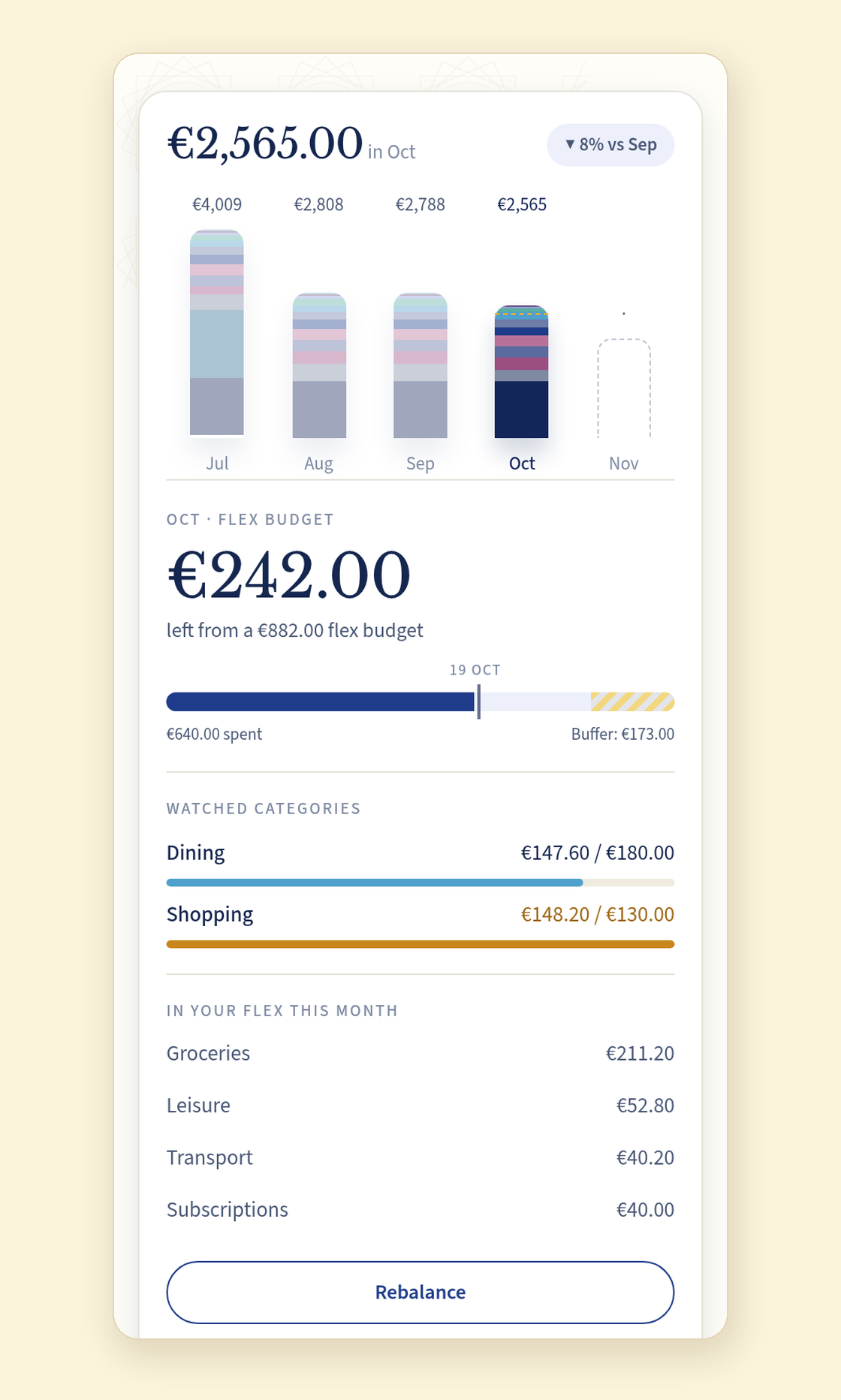
Below the gauge, watched categories show their own progress. Shopping has gone €18.20 over its €130, shown in amber. It is information, not a penalty: the flex budget still has €242 left overall. Everything else spent in the flex budget is listed underneath, so you know where the money went without having had to plan each line.
If the month needs a correction, Rebalance opens the plan for that month in the editor.
When flex is the better choice, and when it is not
Flex works best when:
- You want a simple routine you will keep for years.
- Your variable spending moves between categories from month to month.
- You already have reasonable habits and want visibility, not control.
Envelopes are better when:
- You are trying to change one specific habit and need it on its own line.
- You enjoy the detail.
Nothing is final. In Copio, switching from flex to envelopes proposes a split of your flex amount based on your spending history, which you confirm. Switching back adds the envelopes together. Fixed costs, savings, provisions and the buffer stay as they are.
Envelope or flex budget: how to choose
Promotional note: Copio is the company publishing this article. The household and its figures are fictional and used for illustration only.