
A holiday budget works best when Christmas is paid for before December starts. Gifts, the festive meal, travel to family and a few extra evenings out all land in the same four weeks, on top of a normal month. Planned that late, they end up on a card or an overdraft and spill into January. This guide explains how much to budget, how to spread the biggest part over the year, and how to set it up in Copio.
Figures come from one fictional household used for illustration: a 27-year-old graduate renting alone in Utrecht, in the Netherlands, who takes home €3,100 net a month and sets aside €250 in savings and €200 in investments every month. The salary is anchored on official graduate data: Dutch higher professional education (HBO) graduates earn an average of €3,322 gross a month a year and a half after graduating, according to the HBO-Monitor 2025; our graduate, a few years in, earns €4,000 gross plus holiday pay. The screens are from the Copio app.
Key takeaways
- Split your holiday budget in two: gifts as an annual provision built up over months, and December's other extra spending inside the normal month plan.
- The monthly slice is simple: what is still missing, divided by the months left until December.
- Starting in January makes the slice small. Starting in October makes it painful.
- A year-end bonus is not a plan. Use it for savings and next year's costs first, then a defined share for treats.
What a holiday budget covers
A holiday budget is the total you plan for the festive season: gifts, the Christmas and New Year meals, decorations, travel to see family, and the extra outings that come with December. Most of it is predictable months in advance. What makes it hard is not the amount but the timing: it all arrives at once.
The figures are not small. In France, the Cofidis barometer run with CSA Research put the average Christmas budget for 2025 at €491, with a median of €350, and gifts the largest item at €297. In Germany, a survey commissioned by the retail association HDE found people planned to spend an average of €263 on gifts, €34 less than the year before. Averages hide large differences, so your own last December is the better starting point.
The rule: a monthly slice
The calculation behind an annual provision fits on one line:
monthly slice = (target - already set aside) / months left until the due month
Here is the same €360 gift budget, depending on when you start:
| Start month | Months until December | Monthly slice |
|---|---|---|
| January | 12 | €30 |
| March | 10 | €36 |
| June | 7 | about €51 |
| September | 4 | €90 |
| October | 3 | €120 |
| November | 2 | €180 |
Starting in March costs €36 a month, close to invisible next to an €882 variable budget. Starting in October means finding €120 a month in the three most expensive months of the year. Ignoring it entirely means €360 in one go.
Worked example: Christmas gifts at €360
Our household set a €360 gift budget due in December, which makes a usual slice of €30 a month. By November it should have €300 set aside. It has €270, so it is €30 behind.
With two months left, the plan recalculates: the €90 still missing, spread over November and December, is €45 a month. Accepting that catch-up slice means the household reaches €360 on time. Keeping the usual €30 means arriving at €330 and covering the last €30 from December's other spending.
How to do it in Copio
- Open the plan for the month. Annual provisions sit in their own section of the plan, after fixed costs and the savings you set aside first. Why that order matters.
- Turn a category into a provision. Any category works, including one you create yourself, such as "Christmas gifts". Copio can suggest a target from your spending history, which you edit freely.
- Set the target and the due month. Here, €360 due in December. The plan then sets aside a monthly slice.
- Read the status. On schedule, the provision shows "On track". If it falls behind, it shows "Catch-up needed" and proposes a larger slice.
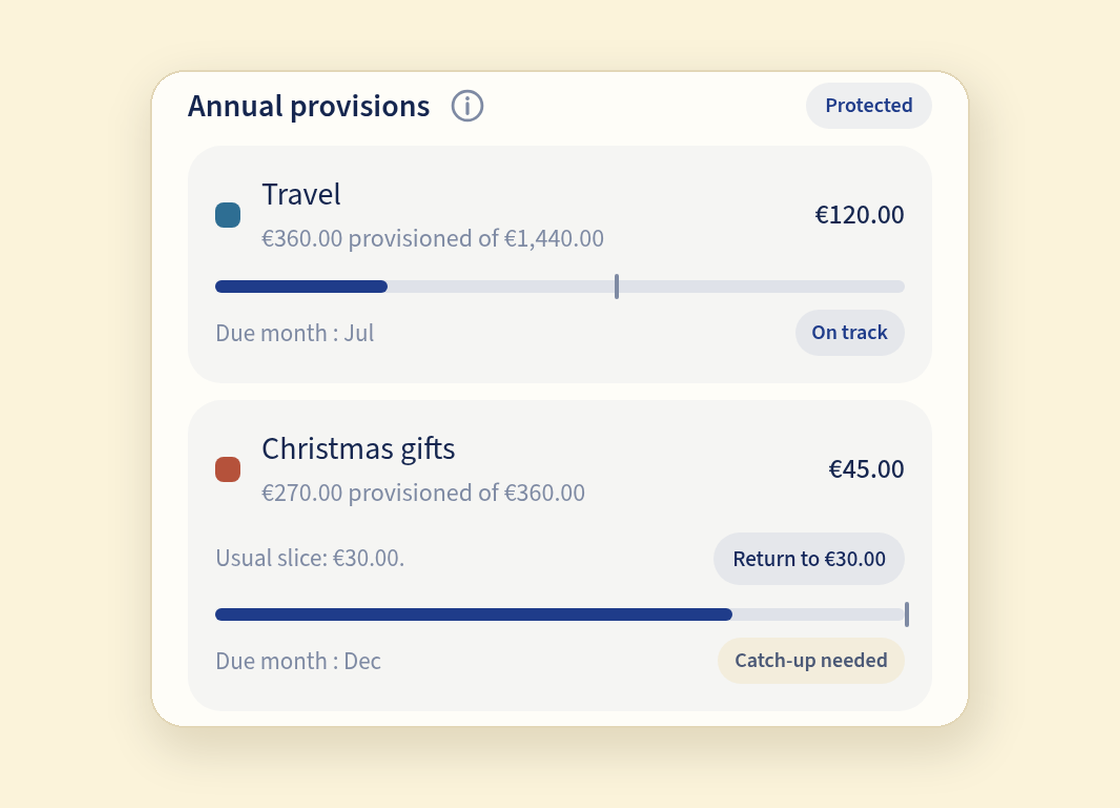
The catch-up slice is a proposal, not an obligation. The card shows your usual slice next to it, and one tap on "Return to €30.00" goes back to it.
Two more things to know. Provisions are protected: when an envelope overspends, Copio never offers a provision as the source to cover it, so December's restaurant bill cannot quietly eat the gift money. And provisions are a reading, not a transfer: no money moves between your accounts. The provision tracks how prepared you are, and you decide where the money actually sits.
December's other spending: the month plan and the buffer
Gifts are the predictable block. The rest of December (more groceries, the festive meal, drinks with colleagues, a train ticket home) belongs in the normal month plan. With envelopes, raise the groceries and dining envelopes for December only. With a flex budget, raise the single flexible amount. Not sure which suits you?
The buffer, the share of income you leave unassigned on purpose, absorbs what nobody planned: the forgotten gift for a neighbour, the extra night in a hotel.
The January aftermath
Spending does not have to show up in the month it happened. A card bill, an overdraft or an instalment plan for December's purchases lands in January or February, on top of a normal month. That is how one expensive December turns into two tight months.
A provision changes the timing. The money for gifts has been prepared over the year, so December spends what was set aside, and January starts at zero. It is also the moment to start again: set next year's provision in January and the slice is at its smallest.
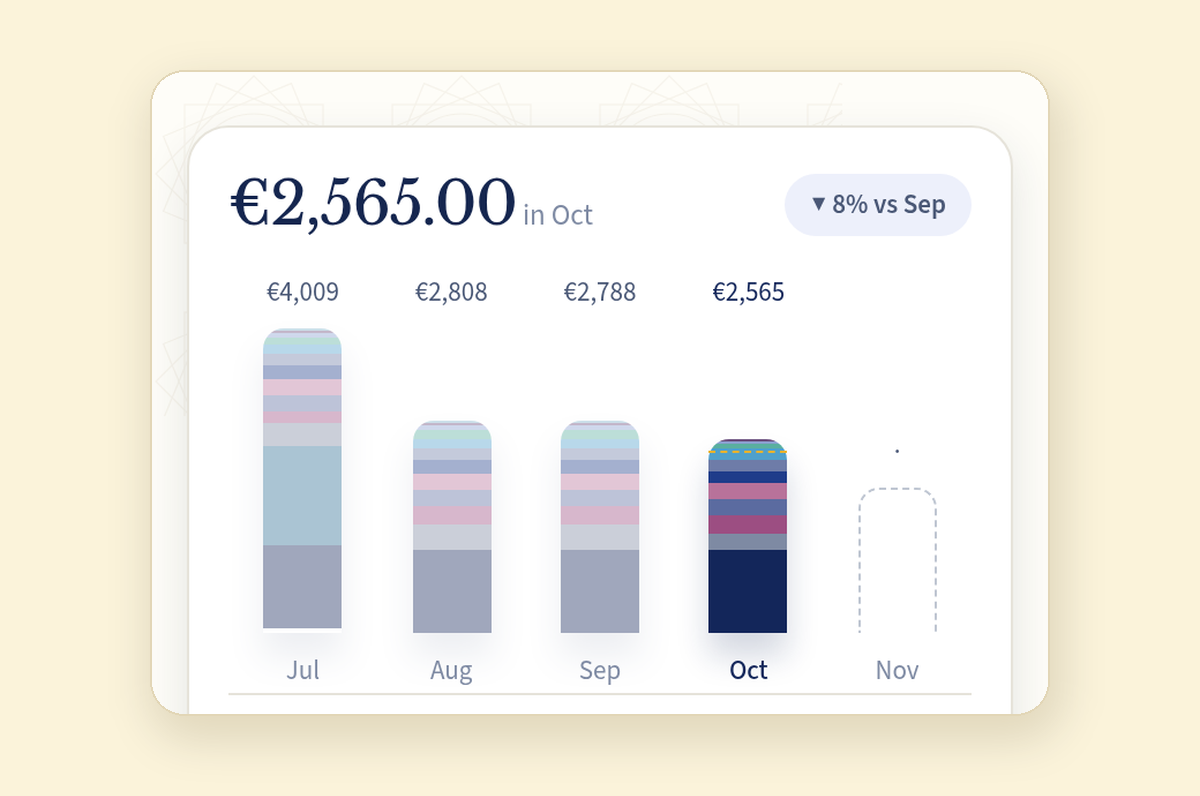
You can see the same pattern with any large cost. Our household's July holiday made it the most expensive month by far:
What to do with a year-end bonus
Many European employees receive a thirteenth month or a Christmas bonus, but it is not universal, and in France and Germany it is not a statutory right. In Germany, a survey by the Hans Böckler Foundation's WSI found that 51% of employees receive Christmas pay, 77% where a collective agreement applies and 41% without one. In France, the thirteenth month is not provided for by the Labour Code and depends on your collective agreement, company agreement, custom or contract. In the Netherlands, the statutory extra arrives in spring instead: holiday pay (vakantiegeld) of at least 8% of gross annual salary, which most employees receive in May or June. Our Utrecht household gets about €1,850 net in May; earmarking a small share of it for December would have kept the gift provision on track.
If you receive one, give it an order before it arrives:
- Savings first. Treat part of it like your monthly set-aside. What savings rate to aim for.
- Next year's irregular costs. Put a share aside for the provisions you know are coming: the holiday, insurance, next Christmas.
- A planned share to enjoy. Decide the amount, then spend it without guilt.
Do not build this year's gift budget on a bonus you are not certain to receive.
Three approaches compared
| Approach | When you pay | Effect on December | Effect on January |
|---|---|---|---|
| No plan | In December, often on credit | Squeezes everything else | Card bill or overdraft to clear |
| December-only budget | In December, from that month's income | Tight but controlled | Usually fine |
| Annual provision | A slice every month, all year | Gifts already prepared | Starts clean |
Common mistakes
- Budgeting gifts only. Food, travel and outings often add as much again.
- Starting in November. The slice is six times what it would have been in January.
- Counting on an uncertain bonus. If it is late, smaller or does not come, the gifts are already bought.
- Raiding savings in December. That is what the buffer and the provision are for.
- Forgetting to restart. The best moment to plan next Christmas is the first week of January.
Start this year, or next
If December is weeks away, a catch-up slice and a slightly larger December plan will still help. If Christmas has just passed, create the provision now: €30 a month is a lot easier to find than €360 in one month.
Promotional note: Copio is the company publishing this article. The household and its figures are fictional and used for illustration only.