Paying yourself first means saving before you spend, not with what is left. It sounds like a slogan, but it is really an order of operations. Most monthly budgets put savings last, after rent, groceries, dinners and impulse purchases, and so savings are what disappear in a tight month. This article explains how to build a monthly plan that starts with you, how to handle the costs that do not arrive every month, what investing first can add up to over decades, why making it automatic works, and how Copio turns that order into a routine.
Figures come from one fictional household used for illustration: a 27-year-old graduate renting alone in Utrecht, in the Netherlands, who takes home €3,100 net a month. The salary is anchored on official graduate data: Dutch higher professional education (HBO) graduates earn an average of €3,322 gross a month a year and a half after graduating, according to the HBO-Monitor 2025; our graduate, a few years in, earns €4,000 gross plus holiday pay. The screens are from the Copio app.
Why "saving what is left" rarely works
Saving what is left at the end of the month has a structural problem: spending expands to fill the space it is given. Without a plan, the money in your current account looks available, and most of it gets used.
Reversing the order changes the default. If €450 leaves for savings and investment on the day your salary lands, the rest of the month adjusts to what remains. You no longer need willpower on the 28th; the decision was taken on the 1st.
The order of a monthly plan
A monthly plan in Copio is built in six steps, always in the same order:
| Step | What it covers | Example household |
|---|---|---|
| Your expected net income, from your last observed months | €3,100 |
| Rent, utilities, insurance (in the Netherlands, including the mandatory basic health insurance), loan repayments | €1,475 |
| What you pay yourself first | €450 |
| A monthly slice of irregular yearly costs | €120 |
| Groceries, dining out, transport, shopping, leisure | €882 |
| What you leave unassigned on purpose | €173 |
Savings sit in third position, right after the costs you cannot avoid. They are funded before any variable spending, and when an envelope overspends during the month, the buffer is the first reserve to absorb it, not your savings.
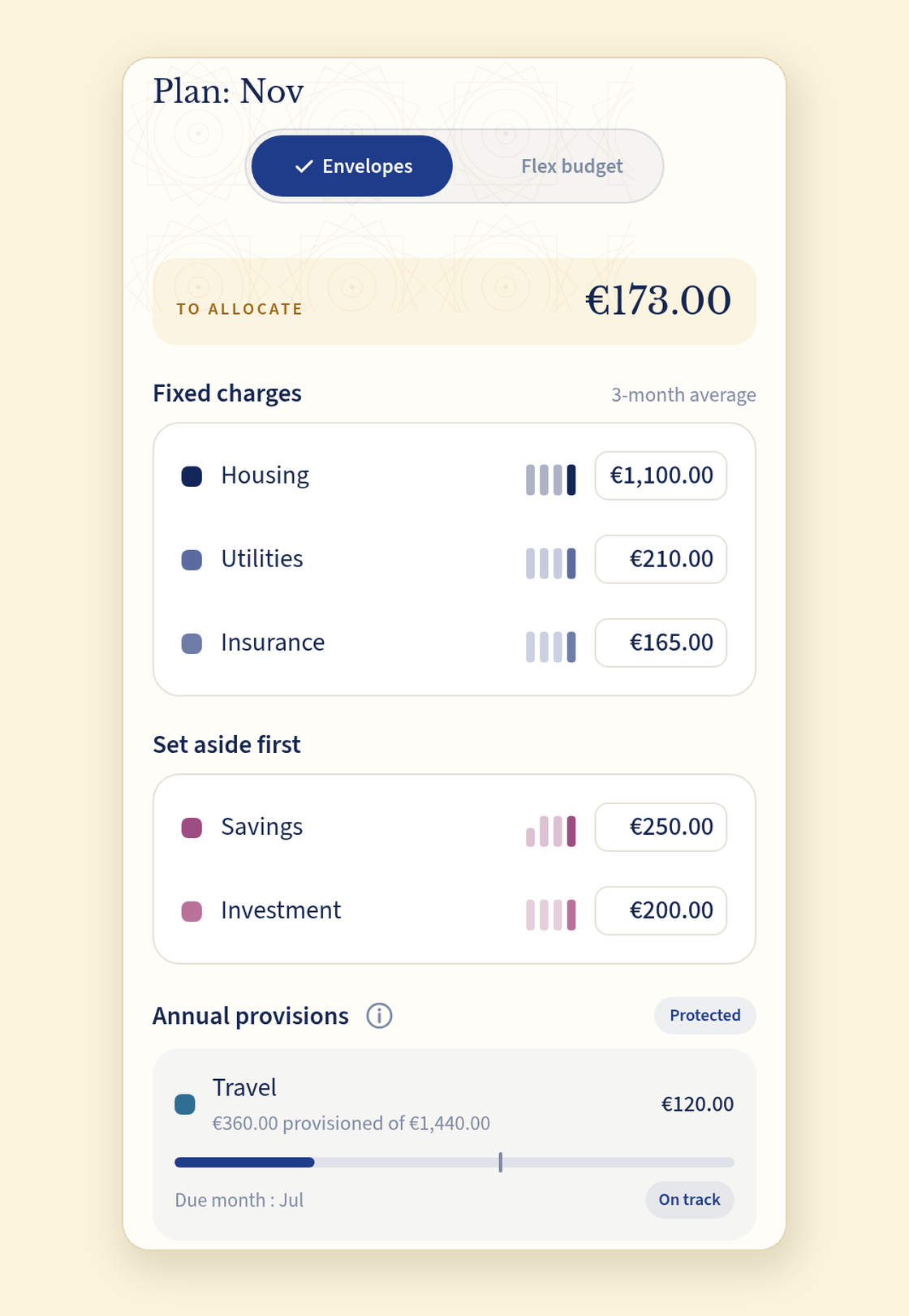
Step 3: savings and investment, as plan lines
In Copio, savings and investment are two lines of the plan, under the heading Set aside first. They are prefilled from your savings target and your history, and each one shows a small bar chart of what you actually set aside in recent months.
During the month, these lines read the other way round from spending. A spending line shows what is left to spend; a savings line shows what is left to set aside. When the €250 transfer to your savings account is detected, the line is complete.
Step 4: the costs that do not come every month
The second classic reason a budget breaks is the irregular cost: the summer holiday, the annual insurance premium, the property tax, Christmas. They are predictable over a year but invisible in any single month, so they arrive as a shock.
You can see it in our household's spending. July, with the holiday, cost €4,009. August and September cost about €2,800 each. (These monthly totals include rent and the amounts set aside, which is why they are close to income in an ordinary month.)
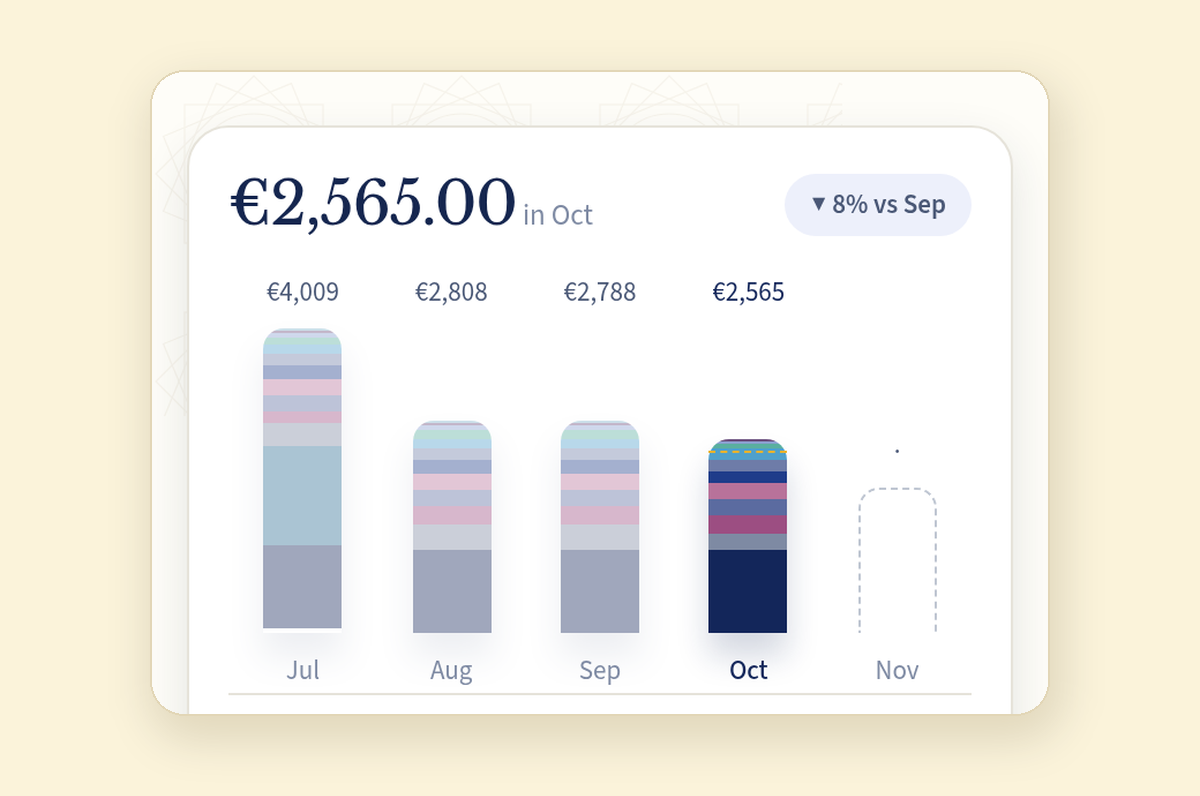
The fix is an annual provision. You set a yearly target and a due month, and the plan sets aside a monthly slice. Our household's €1,440 trip next July becomes €120 a month. By November, €360 is provisioned and the provision is shown as on track.
In the Netherlands, one irregular payment arrives on the income side too: holiday pay (vakantiegeld), at least 8% of gross annual salary, which most employees receive in May or June. For our household it is about €1,850 net in May. Decide its split before it lands (a share to savings, a share to provisions, a share to enjoy), or it melts into an ordinary month.
A few things to know about provisions in Copio:
- They are protected: a provision is never offered as a source to cover an overspend elsewhere.
- They are a reading: no money is moved between accounts. The provision tracks your preparation, so you can decide where the money sits.
- They catch up: if a provision falls behind, the plan shows it and suggests the slice needed to be ready on time.
- They come from your history: Copio can suggest turning a category into a provision, with a target estimated from your past spending, which you edit freely.
Step 6: the buffer, by design
Even a good plan meets a bad week. The buffer is the part of income you deliberately leave unassigned so that a broken washing machine or an expensive month of dinners does not reach your savings.
In Copio, you do not have to calculate it. Whatever you have not given a role when you save the plan is added to the buffer automatically, and the app tells you the amount. Our household keeps €173.
What investing first adds up to over time
Our household pays itself €450 first, and €200 of it goes to investment: 6.5% of its net income, on top of the workplace pension already deducted from its salary. Held every month for decades, that line is what turns a monthly habit into long-term wealth. And because the amount is decided at the start of the month, raising it by one point of income (€31 a month, 1% of €3,100) is a single change to the plan, not a monthly act of willpower.
Here is what these amounts could be worth at 65, in today's euros, in the central scenario, with the unfavourable and favourable scenarios in brackets:
| Monthly investment | From 27 to 65: paid in | Value at 65 | From 37 to 65: paid in | Value at 65 |
|---|---|---|---|---|
| €200 (today's line) | €91,200 | €225,600 (€118,000 to €361,400) | €67,200 | €128,400 (€81,100 to €178,000) |
| €31 (one extra point) | €14,136 | €35,000 (€18,300 to €56,000) | €10,416 | €19,900 (€12,600 to €27,600) |
| €231 (both together) | €105,336 | €260,600 (€136,300 to €417,400) | €77,616 | €148,200 (€93,600 to €205,600) |
Two things stand out. Time does more than the amount: starting the €200 at 37 instead of 27 means €24,000 less paid in but about €97,300 less at 65, a drop of more than 40% in the central scenario. And the extra point is cheap today and large later: €31 a month from 27 adds about €35,000. The simulator below opens on our household's income, one extra point and a start at 27; move the sliders to try your own figures.
Simulator: invest one more point of your income
Move the sliders to see what an extra share of your net income, invested every month from a given age, could be worth at 65. Figures are in today's euros (after inflation).
€31 a month · Total you put in: €14,136
Value at 65, in today's euros, by scenario
Start at 37 instead and the central result falls to €19,894 (43% less).
Start at 27 Start at 37Age
Assumptions: a diversified growth portfolio based on Copio's published capital market assumption for global equities (6.4% a year, nominal, in euros), minus 2% inflation, so about 4.3% a year after inflation in the central case. The unfavourable and favourable cases use 3 points less and 2 points more. Contributions stay constant in today's euros; fees and taxes are not deducted.
Illustration only, not a forecast or personal advice. Investing involves risk, including the loss of capital, and returns can be negative for long periods.
How the simulator works: the central scenario starts from Copio's published capital market assumption for global equities, 6.4% a year nominal in euros, and subtracts 2% inflation, which gives about 4.3% a year after inflation. The unfavourable scenario uses 3 points less and the favourable one 2 points more. Contributions stay constant in today's euros, and fees and taxes are not deducted, so actual results would be lower. For how the savings rate and the investment rate fit together, read what a good savings rate is and how to calculate yours.
Risk warning: these figures are an illustration, not a forecast and not personal advice. Investing puts your capital at risk, markets can fall sharply, and returns can stay negative for long periods. Keep your emergency savings in place first, and only invest money you will not need for many years.
Why automatic saving works: the evidence on automatic enrolment
Paying yourself first works for the same reason automatic enrolment in pensions works: most people stick with whatever happens by default. Economists have tested this for 25 years, and the results are consistent.
- Defaults raise participation. At a large US employer studied by Madrian and Shea (2001), 37% of employees hired just before automatic enrolment had joined the 401(k) retirement plan after 3 to 15 months, against 86% of those hired under it. The catch: 76% of the automatically enrolled stayed at the default 3% contribution rate, and 80% of their contributions stayed in the default money-market fund, so the default level and investment matter as much as the default itself.
- Pre-committed increases raise the rate. In Thaler and Benartzi's Save More Tomorrow plan (2004), employees agreed in advance to raise their contributions with each pay rise. Participants' average saving rates rose from 3.5% to 13.6% over 40 months.
- It works at national scale. After the UK introduced automatic enrolment from 2012, workplace pension participation among eligible employees rose from 55% in 2012 to 90% in 2025, and from 42% to 88% in the private sector, according to the Department for Work and Pensions.
- Automatic beats incentives. Using Danish data, Chetty and co-authors (2014) found that about 85% of people are passive savers. Extra automatic contributions raised total saving almost one for one (about 80 cents per euro), while tax subsidies raised total saving by only about 1 cent per euro of public money spent.
- It is not simply borrowed back. In the US Army's civilian savings plan, Beshears and co-authors (2022) found that automatic enrolment raised cumulative contributions by 4.1% of annual salary after four years, with no significant rise in debt (excluding car loans and first mortgages).
The lesson for your monthly plan is to make the set-aside a default rather than a decision:
- Automate it on payday. Set up a standing order from your current account to your savings and investment accounts for the day your salary lands, or an automatic monthly investment plan (periodiek beleggen in the Netherlands; the same idea is a versement programmé in France and an ETF-Sparplan in Germany).
- Choose the default well. Madrian and Shea's result is a warning: an automatic amount set too low, or left in cash for decades, can cost more than it gains. Pick the amount and the investment deliberately.
- Raise it with your pay. When your salary goes up, raise the standing order the same day, before the extra income becomes spending. That is Save More Tomorrow applied to yourself.
In the Netherlands, most employees already have one automatic saver working for them: workplace pensions are near-compulsory through collective labour agreements, and the contribution is taken before net pay arrives. Paying yourself first adds a second automatic line, one you control.
Copio does not move your money: it connects to your accounts in read-only mode. What it does is put savings and investment first in the plan and show when each transfer has landed, so you can see every month that the automation did its job.
Then choose how to manage the rest
Once fixed costs, savings, provisions and the buffer are set, what remains is your variable spending. Copio offers two ways to manage it:
- Envelopes: one limit per category, for detail and for changing specific habits. How the envelope method works
- Flex budget: one amount for all everyday spending, for simplicity. How flex budgeting works
Both share the same order. Whichever you choose, you are paid first.
Promotional note: Copio is the company publishing this article. The household and its figures are fictional and used for illustration only.