Managing money as a couple comes down to two decisions: how you hold your money (joint, separate or both) and how you split what you share. Neither has a universal right answer, and the arrangement that works at 25 may not work at 40. What helps is choosing on purpose, with real figures, and checking in regularly. This article compares the three common account models, works through three ways to split shared costs, and shows how Copio gives a couple one view of the household without merging everyone's personal finances.
Figures come from one fictional household used for illustration: a 27-year-old graduate renting in Utrecht, in the Netherlands, who takes home €3,100 net a month and sets aside €250 in savings and €200 in investment monthly, living with a partner, Sam, who earns €2,800 net. The salary is anchored on official graduate data: Dutch higher professional education (HBO) graduates earn an average of €3,322 gross a month a year and a half after graduating, according to the HBO-Monitor 2025. The screens are from the Copio app.
Key takeaways
- There are three common models: everything joint, everything separate, or yours, mine and ours (one account each plus a joint account).
- Shared costs can be split 50/50, in proportion to income, or so that both partners keep the same amount left over. The gap between them grows with the income gap.
- A joint account usually makes co-holders responsible for its debts, and the default property rules of marriage differ from country to country.
- A short monthly money check-in does more for a couple than a perfect system set up once.
The three ways couples hold their money
| Model | How it works | Suits couples who | Watch out for |
|---|---|---|---|
| Everything joint | Both incomes arrive in one account that pays for everything | Want simplicity and full transparency | Less personal autonomy, and both are exposed to the account's overdraft |
| Everything separate | Each partner keeps their own account and they settle shared costs between them | Value independence, or are early in the relationship | Shared costs are harder to follow, and settling up can become a running tally |
| Yours, mine and ours | One account each, plus a joint account funded every month for shared costs | Want shared bills handled together and personal spending kept personal | Agreeing how much each partner pays into the joint account |
Habits vary a lot across Europe. In a Legal & General survey of 1,052 cohabiting UK adults from 2019, 32% shared everything in joint accounts and 32% kept finances fully separate. In Germany, a 2023 YouGov survey for Postbank of 1,261 people in a relationship found 45% using two separate accounts, 33% a joint account only, and 18% the three-account model, up from 13% in 2011.
How to split shared costs: three rules
Once you know which costs are shared (typically rent, utilities, insurance, groceries), you need a rule for who pays what.
- 50/50: each partner pays half. Simple, and fair when incomes are close.
- In proportion to income: each partner pays the same percentage of their income. Your share = your income ÷ combined income × shared costs.
- Equal amount left over: you split so that both partners keep the same amount after shared costs. This treats the household as one pot.
In France, a February 2026 survey by the Cité de l'Économie and Institut Bona fidé found that 50% of people in a couple split expenses equally and 30% in proportion to income, rising to 41% among 18 to 24 year olds.
Worked example
Our household earns €5,900 a month combined: €3,100 for you and €2,800 for Sam. Shared costs come to €2,360 a month (rent for a two-room flat, utilities and groceries); each partner pays their own Dutch basic health insurance. Your income is about 52.5% of the total, Sam's about 47.5%.
| Rule | You pay | Sam pays | You keep | Sam keeps |
|---|---|---|---|---|
| 50/50 | €1,180 | €1,180 | €1,920 | €1,620 |
| In proportion to income (about 52.5/47.5) | €1,240 | €1,120 | €1,860 | €1,680 |
| Equal amount left over | €1,330 | €1,030 | €1,770 | €1,770 |
With a 50/50 split, Sam spends 42% of their income on shared costs, while you spend 38%. With the proportional split, both of you spend 40%. With the third rule, you each keep €1,770. Because the two incomes are close, the three rules are only €150 a month apart for you; the gap grows quickly as incomes diverge. None of these is the correct answer: it depends on what feels fair to both of you, and on what each partner still has to fund personally, including their own savings. If you pay yourself first, the split has to leave room for it. How to build a monthly plan that starts with savings
The legal layer differs by country
Account models are a practical choice, but the law adds its own rules, and they vary across Europe.
- Joint accounts: in France, the official guidance on joint bank accounts states that co-holders are jointly responsible, so the bank can turn to either of them to settle an incident. In Germany, the Verbraucherzentrale explains that on an account where each holder can act alone, the whole account can be seized for one holder's debt.
- Marriage without a contract: the default regime is not the same everywhere. In France, income earned during the marriage becomes common property (communauté réduite aux acquêts). In Germany, each spouse's assets stay separate during the marriage and the gains are balanced when it ends (Zugewinngemeinschaft, § 1363 BGB).
- Couples across borders: for international couples, an EU regulation on matrimonial property regimes, applicable since 29 January 2019 in the participating Member States, sets which country's law applies.
This is general information, not legal or tax advice. Before you open a joint account, marry, or sign a civil partnership, read the official guidance where you live or ask a notary or lawyer.
A monthly money check-in
Money is a sensitive subject for many couples. In a 2025 Opinium survey for Legal & General of 3,000 UK adults in a relationship, 18% said they often argue about money and 17% avoid the conversation altogether, and 36% did not clearly understand their partner's pension savings.
A short, regular check-in keeps each conversation small. Thirty minutes once a month is enough:
- Look back: how did the month go? Any surprises?
- Shared costs: did the split still work? Has a bill changed?
- Savings: what did the household set aside, as a share of combined income? What savings rate to aim for
- The bigger picture: where does your household net worth stand? How to calculate net worth
- Coming up: irregular costs in the next few months, such as holidays or the end of the year. Planning a holiday budget
- Decide: agree on one or two actions, no more.
How to do it in Copio
Copio lets two users link their accounts into a Household. Each partner keeps their own personal view, and a Personal / Household toggle switches between personal and household figures.
- Both partners connect their accounts in their own Copio app, as usual.
- Link your accounts into a household. One partner taps Generate a code, the other enters it with I have a code. Once linked, you see combined totals only, never the detail of each other's accounts. A combined total can still hint at each person's share by subtraction, so agree on it together.
- Mark shared accounts as joint. Open a connected bank account and choose to declare it joint. The Joint accounts card shows how many accounts are marked, and joint accounts and transfers between you are not counted twice in the household figures. The Manage household entry gathers the household settings.
- Switch to Household for your check-in. You see the household savings rate and investment rate as a share of combined income, month by month, and the household net worth, split between liquid and invested.
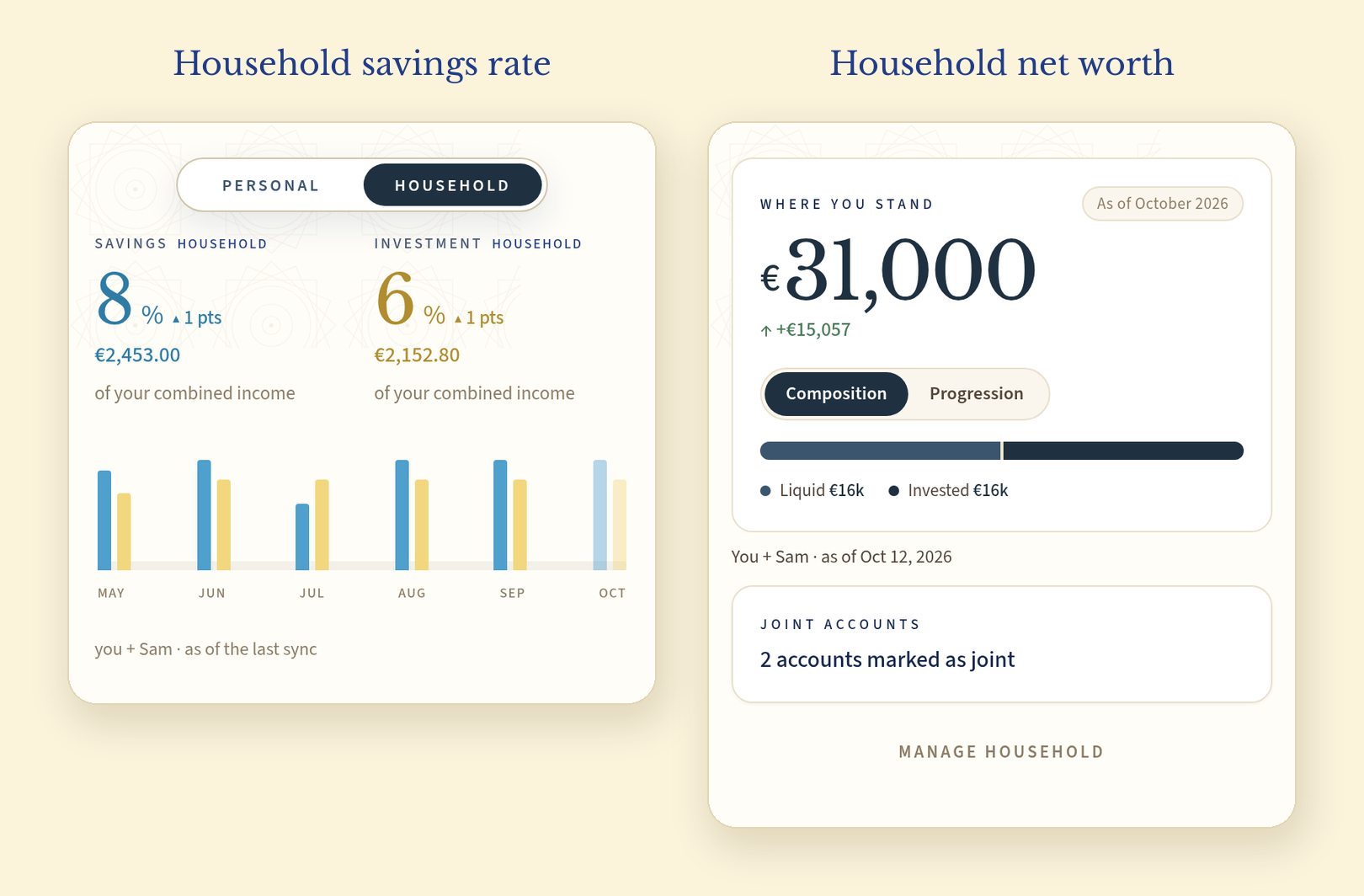
In our household, savings represent about 8% of the €5,900 combined income and investment about 6%; the amounts on the card are totals over the six months shown. Household net worth is €31,000, split roughly evenly between liquid and invested money (€15,500 each, rounded to €16k on screen), and two accounts are marked as joint.
The monthly plan in Copio is personal: each partner keeps their own plan, with their own savings lines and their own way of managing everyday spending, envelopes or a flex budget. The household view is where you meet to look at the shared picture.
Common mistakes
- Choosing a split once and never revisiting it. A pay rise, a new job or a child changes what is fair.
- Counting the joint account twice. If both partners add it to their own total, household net worth looks bigger than it is.
- Letting one partner run everything. Even if one of you handles the admin, both should know the main figures: income, savings, debts and pensions.
- Treating the split as the whole plan. Splitting costs fairly says nothing about whether the household is saving enough.
- Opening a joint account without reading the terms. Check who can use it alone and who is liable for an overdraft.
Whatever model you choose, the aim is the same: two people who can each see where they stand, and one shared picture to talk about once a month.
Promotional note: Copio is the company publishing this article. The household and its figures are fictional and used for illustration only.